
What happens if you don’t submit your tax return?
The real cost of SARS administrative penalties, which run from R250 to R16,000 a month and keep accruing for years. Here are the actual numbers.
The penalty, per month, per return
SARS charges a fixed amount administrative penalty for every month an income tax return remains outstanding. The amount depends on your income, and it is charged for each return you have not filed rather than once overall.
| Your position | Penalty each month |
|---|---|
| Assessed loss or low income | R250 |
| Taxable income between R250,000 and R500,000 | R500 |
| Taxable income above R500,000 | Up to R16,000 |
Charged monthly, per outstanding return, until the return is filed.
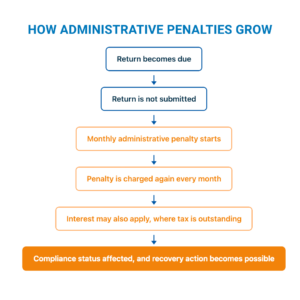 Filing the outstanding return is what stops the sequence. It can be stopped at any point in it.
The final row is the one that gets people’s attention. For taxpayers in the highest bracket that is R16,000 a month, on a single return that was never filed.
Filing the outstanding return is what stops the sequence. It can be stopped at any point in it.
The final row is the one that gets people’s attention. For taxpayers in the highest bracket that is R16,000 a month, on a single return that was never filed. How long it runs, and the detail that costs you a year
The penalties do not stop after a few months. They keep being levied every month until the return is filed, up to a limit.
- 35 months if SARS has your current address.
The penalty is not the only cost
Administrative penalties are charged for the failure to file. They sit alongside, not instead of, everything else:
- The tax itself, which still has to be paid once the return is assessed.
- Interest on any amount owing, which runs from the original due date rather than from the day you eventually file.
- Understatement penalties, where SARS finds that income was understated rather than simply undeclared.
The distinction matters, because it is commonly misunderstood. Administrative penalties are separate from any tax that may still be payable. Paying the penalty does not replace your tax liability. It is an additional consequence of not filing, charged on top of whatever the return itself turns out to owe.
So the order matters. Filing late is expensive. Filing late and owing tax is considerably worse, because the interest has been accruing quietly the whole time.
Where TTT Financial Group manages your tax affairs, we deal directly with SARS on your behalf and keep you informed at each stage, so a penalty is not the first you hear of a problem.
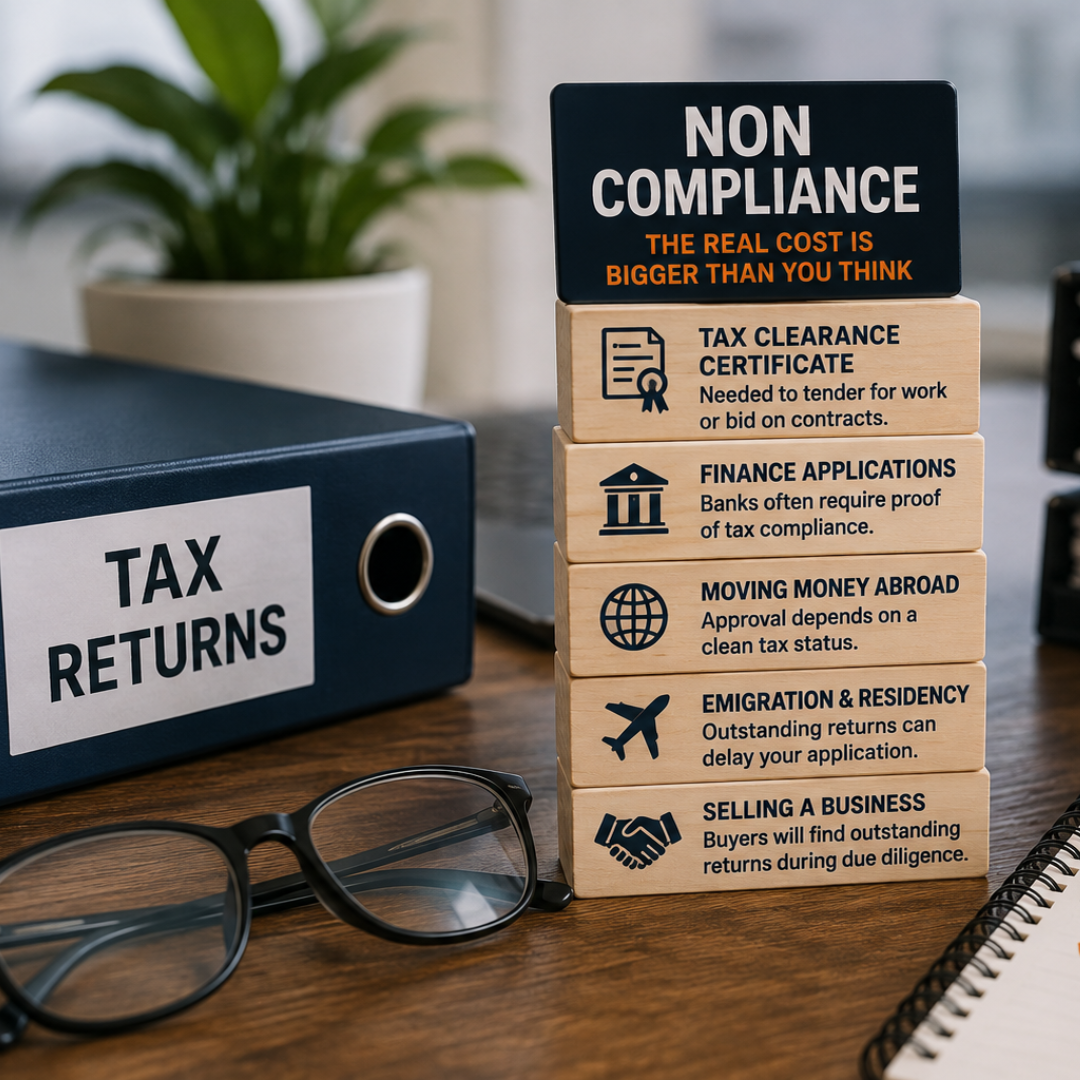
What non compliance costs when it is not about money
An outstanding return does not sit quietly on a SARS system. It changes your compliance status, and that status is what gets checked when you need something.
- A tax clearance certificate, which you need to tender for work or bid on contracts
- Finance applications, where a bank asks for proof of compliance
- Moving money abroad, where approval depends on a clean status
- Emigration and residency processes
- Selling a business, where a buyer’s due diligence will find it
This is how people usually discover the problem. Not through a letter, but through a deal that stalls. And at that point the timeline is no longer yours, because filing years of returns properly takes weeks, not an afternoon.
Nobody plans this
Most outstanding tax returns do not begin with someone deciding not to comply. They usually start with something much more ordinary:
- They thought they were below the threshold. Often because they were, once, and their income changed.
- They left the country and assumed South African obligations ended at the airport.
- A company went dormant and nobody told SARS, so its returns kept falling due.
- They could not find the documents one year, meant to sort it out, and the year became four.
- Someone else was responsible for their tax affairs, and they assumed everything had been submitted.
That last one is worth its own paragraph. We regularly see clients who relied on informal advice, or who assumed a family member, a friend or a former bookkeeper had taken care of their returns. Those assumptions are rarely dishonest and they routinely lead to years of outstanding returns.
It is also why a nil return, a form submitted with zeros in it to make a problem go away, is such a common and such a damaging shortcut. It produces a clearance certificate that suggests everything is in order when nothing is, and it is exactly the kind of thing SARS is now finding.
SARS is much better at finding this than it used to be
The old assumption that an unfiled return might simply be missed no longer holds. SARS receives data directly from employers, banks, medical schemes, retirement funds and investment providers, so it generally knows roughly what you earned whether you filed or not.
SARS has significantly increased its compliance activities in recent years, using information received from employers, banks, medical schemes, retirement funds and investment providers to identify non-compliance.
Legislation has been moving in the same direction. Amendments have been proposed that would allow banks to flag and briefly hold refunds suspected of being linked to a tax offence, which tells you where the direction of travel is. The gap between not filing and being found is closing.
Our role is to resolve these matters before they become more expensive, while handling the communication with SARS on your behalf.
From establishing which returns are outstanding to communicating directly with SARS, our team manages the process on your behalf so you do not have to navigate it alone.
If you already have penalties
Beyond that there are two routes, and both have deadlines of their own:
- Remission. Where there are grounds for it, a request for remission of a fixed amount penalty can be made. It should be lodged before the due date shown on your penalty Statement of Account, and SARS has 30 business days to respond.
- Dispute. Where the penalty is simply wrong, it can be disputed. A Notice of Objection has to be lodged within 80 business days of the assessment, and SARS has 60 business days to decide it.
Both need grounds and supporting documents. Neither is a phone call, and neither works after the period has run.
What we would not advise is opening the statement, seeing the total, and closing it again. Penalties on unfiled returns are one of the few tax problems that get strictly worse with every month of silence, and one of the few where the remedy is entirely in your hands.
We assess your position, prepare the outstanding returns, communicate with SARS, and guide you through the remission or objection process where there are grounds for it.
How we help clients get back on track
Bringing outstanding returns up to date is work we do regularly, and it usually runs in this order:
- We establish what is actually outstanding, which is often not what the client thinks. Dormant company years and old provisional periods are the usual surprises.
- We pull your full SARS position, including every penalty, the periods they relate to, and any interest already accrued.
- We reconstruct the returns, which means finding the documents rather than filing zeros.
- We file, in the right order, because the sequence affects the outcome.
- We deal with the penalties, through remission or dispute where there are grounds, and we do it inside the periods that apply.
- We fix what caused it, including your registered details, so an outdated address is not costing you an extra year next time.
The first step is a conversation, not a pile of paperwork. Most people who call us about this have been dreading it for years and are surprised by how quickly the picture becomes clear.
Do I have to file if I earn under the threshold?
Sometimes not, but the threshold is not the only trigger. Income outside a salary, more than one employer, a travel allowance, rental income or a business can all create an obligation even at modest income levels. Reporting suggests anyone earning above R500,000 a year is required to file. If you are unsure whether a return was due, that is exactly the question to ask before penalties decide it for you.
Will SARS waive penalties if I explain?
Not on explanation alone. There is a formal remission process and it requires grounds, submitted before the due date on your penalty statement. A good reason presented properly has a chance. The same reason mentioned on a phone call has none.
How far back can SARS go?
Further than most people expect. Penalties can be levied for up to 35 months per return, or 47 where your address is out of date, and outstanding returns from several years ago can still be raised. Time does not clear an unfiled return.
Is it cheaper to just pay the penalty?
No, and this is the most expensive misunderstanding on this page. The penalty continues to be charged every month until the return is filed. Paying the current balance without filing simply means paying again next month.
What if I cannot find the documents?
This is the most common reason people stall, and it is rarely fatal. Most of what is needed can be reconstructed from third party data, employer records and bank statements. Send us what you have and we will tell you what can be rebuilt.
Can I still get a refund if I file late?
Filing late does not automatically mean losing a refund. If the return shows that too much tax was deducted during the year, that overpayment does not disappear because the return went in after the deadline.
There are three things that commonly get in the way. A refund can be set off against penalties, interest or tax already owed on your account, so it may reduce or vanish into an existing balance. Other outstanding returns can hold payment up across your whole profile. And for older years, time limits can apply to how far back a refund can be claimed.
The practical answer is that a late return is still worth filing properly, because the alternative is penalties with no refund at all. If you want to know whether a refund is likely in your case, send us your details and we will check the position.
Not sure if you have outstanding returns?
- Check your SARS profile
- Identify any outstanding returns
- Calculate the administrative penalties already raised
- Deal directly with SARS on your behalf
- Bring your tax affairs up to date